What it looks like
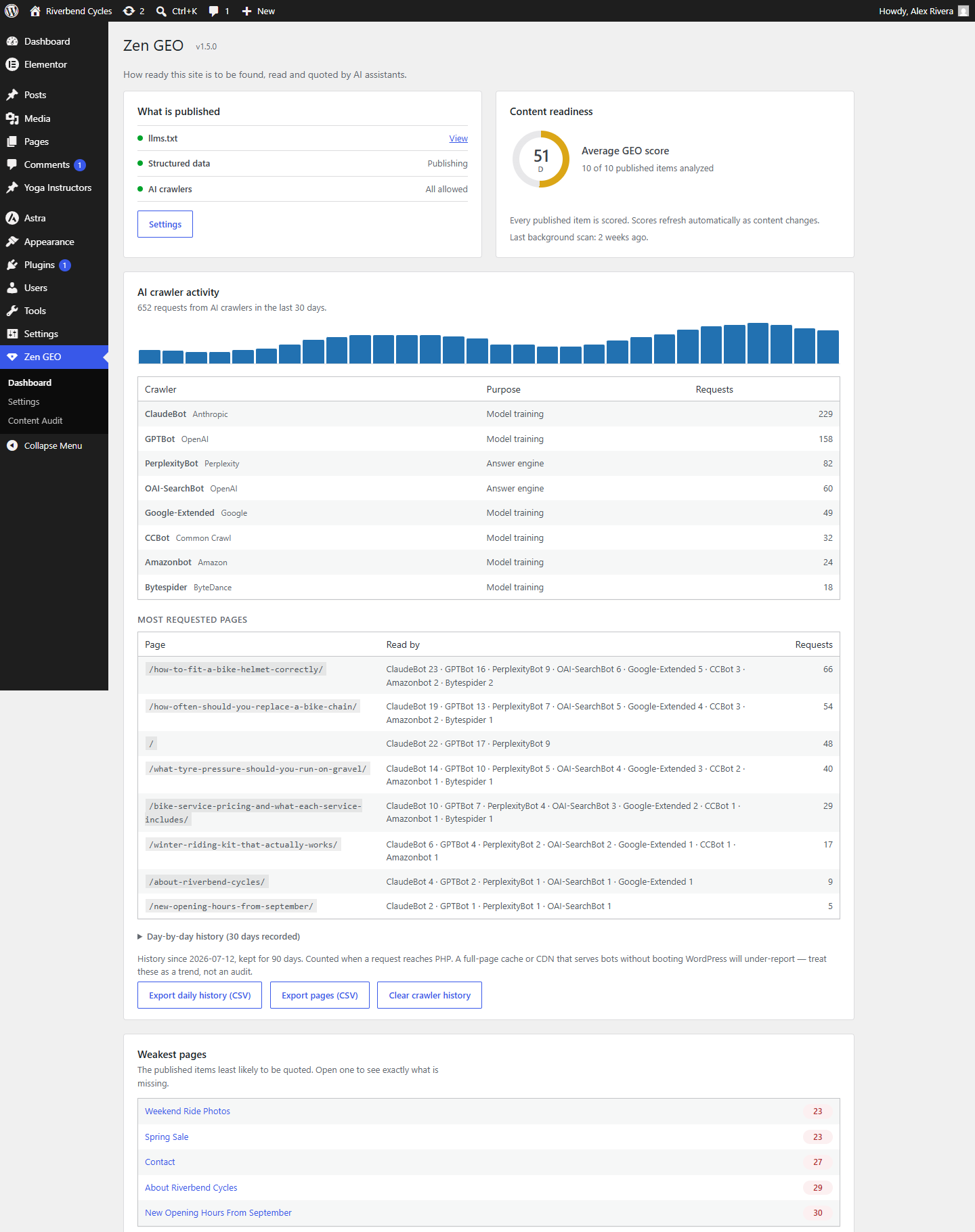
The dashboard answers two questions: how quotable this site's content is, and which assistants have actually been reading it.
Search used to send people to your page. Increasingly, an assistant reads your page and answers on your behalf — and only sometimes cites you. Zen GEO makes sure that when an assistant answers a question in your field, it can find your content, understand it, quote it accurately, and name you as the source.
Or search for Zen GEO under Plugins → Add New in your WordPress
admin — wp plugin install zen-geo --activate
Publishing an llms.txt file is a few lines of code, and plenty of plugins stop there. Zen GEO treats that as one output of the job rather than the job.
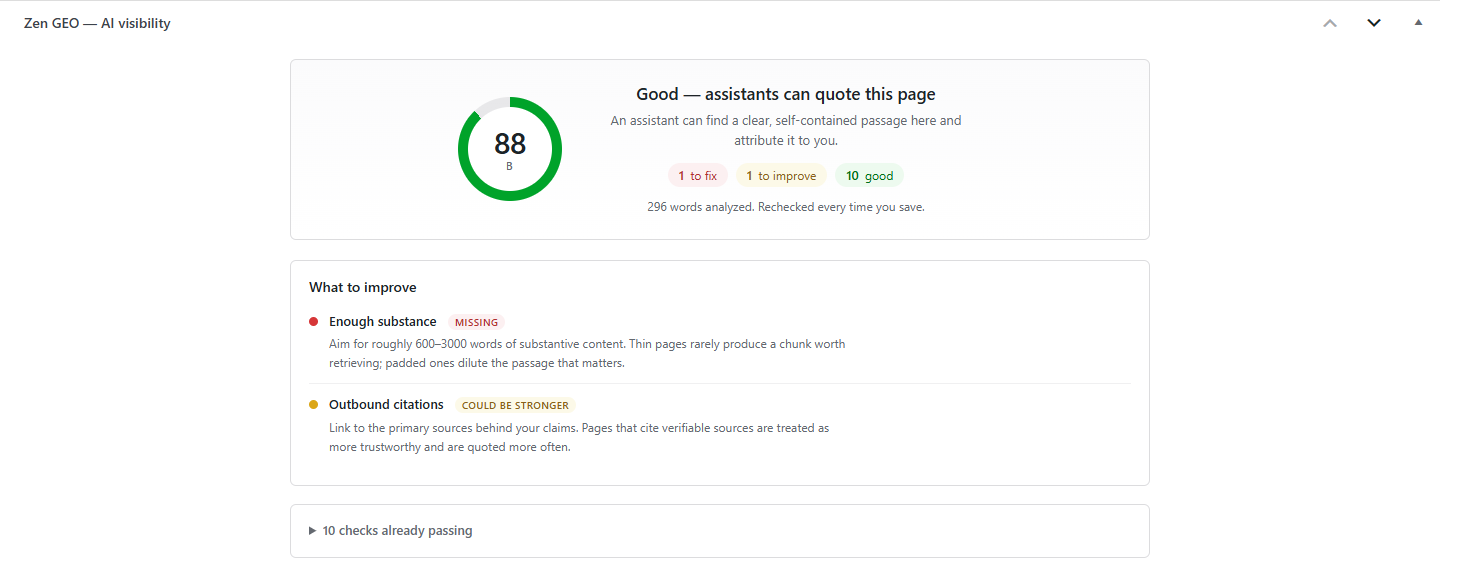
Twelve weighted checks model how retrieval-augmented systems actually behave: they chunk a page, embed the chunks, retrieve a few, and quote whichever one answers the question on its own. Every failing check gives a specific instruction, not a colour.
Content is extracted from Elementor's stored element tree, so pages built with Elementor,
its Pro widgets or third-party widgets are scored on their real text — not on an empty
post_content, which is where most content analysers give up.
Not just that AI crawlers visited: a per-page, per-crawler breakdown with 90 days of history, stored in your own database, with no IP addresses recorded.
Question-and-answer pairs are read out of Elementor accordions, toggles and Details blocks and published as FAQPage data, with nothing retyped. Only question-shaped headings count, so a list of section names is left alone.
Yoast SEO, Rank Math, All in One SEO, SEOPress and Slim SEO are detected, and Zen GEO stands down where they already emit structured data. Two competing Article graphs on one URL is worse than one.
A tab inside the Elementor editor beside Widgets and Globals, a WordPress meta box, a Dashboard widget, a sortable post-list column, a site-wide audit with CSV export, and WP-CLI commands for bulk work.
The dashboard answers two questions: how quotable this site's content is, and which assistants have actually been reading it.
| Surface | What it is |
|---|---|
/llms.txt |
A Markdown index of your site following the llmstxt.org convention: your site name, a summary, and annotated links to the pages that matter. |
/llms-full.txt |
Optionally, the same pages with their full text inlined, for assistants that fetch one document instead of crawling. |
?zengeo=md |
Every page as clean Markdown — no theme, no navigation, no cookie banner.
Advertised in each page's <head> so crawlers find it on their own. |
| JSON-LD | One consolidated graph — Organization or Person, WebSite, Article/WebPage, BreadcrumbList — cross-referenced so an engine reads one coherent statement. Plus sameAs, FAQPage, speakable, LocalBusiness and WooCommerce Product. |
/robots.txt |
Per-crawler allow or disallow for 19 AI crawlers, plus optional enforced 403 blocking at the PHP layer and custom validated directives. |
Crawlers are grouped by what they actually do — model training, answer-engine indexing, or a fetch triggered by a real person — because blocking the second kind removes you from AI answers entirely, and most people who say "block AI" do not mean that.
Zen GEO makes no external network requests of any kind. It does not phone home, has no licence server, collects no telemetry, and loads no remote assets. Crawler analytics are stored in your own database and never leave it. No IP addresses are recorded.
The category is full of overpromising. To be clear about what this does not do: